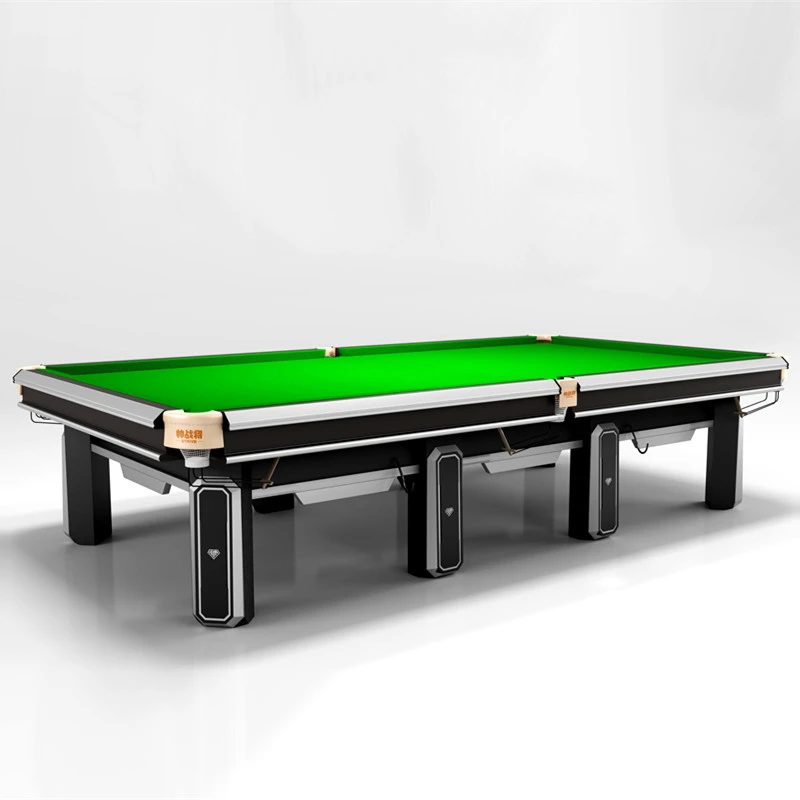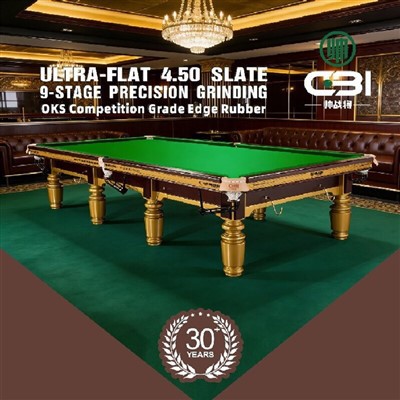
When installing a billiard table, it is necessary to reserve expansion space to avoid problems such as cracking of the stone slabs and deformation of the frame. The local temperature and humidity vary greatly, and wooden components are prone to expansion and contraction. Professional advice includes ground leveling, temperature and humidity control, and regular leveling to ensure the long-term stable use of the billiard table.
Before installing a billiard table, it is necessary to reserve expansion space. This requirement is based on material properties, environmental factors and usage needs. The specific analysis is as follows:
1. The material properties determine the necessity of expansion space
SLATE desktop
Although the core components of a billiard table, such as bluestone slabs, have high density and strong stability, they may still undergo slight deformation due to temperature changes. If no expansion space is reserved during installation, the stone slab may crack or deform due to compression during thermal expansion and contraction, affecting the accuracy of the ball path.
Wooden frame and rubber edge
Wooden components (such as frames and warehouse edges) are sensitive to humidity. They tend to expand in a humid environment and contract in a dry one. The elasticity of the rubber edge is also affected by temperature. Reserving space can prevent the edge of the warehouse from loosening or rebounding abnormally due to material deformation.
2. Environmental factors intensify the risk of inflation
The region has distinct four seasons, with significant fluctuations in temperature and humidity. High temperature and humidity in summer may cause wooden components to expand, while low temperature and dryness in winter may lead to contraction. If environmental changes are not taken into account during installation, the billiard table may undergo seasonal deformation:
Misalignment of the stone slab joints: causes the ball path to shift;
Inconsistent elasticity at the edge of the reservoir: affecting hitting feedback;
Frame deformation: Causes the desktop to be uneven.
3. Space reservation is forced by usage demands
Hitting comfort
A standard billiard table (such as a Chinese 8-ball table) measures approximately 2.83 meters by 1.55 meters, and at least 1.5 meters of swing space should be reserved around it. If the expansion allowance is not taken into account during installation, the swing area may be forced to be compressed due to insufficient space later on, which will affect the technical performance.
Long-term maintenance costs
Reserving expansion space can reduce the frequency of maintenance caused by material deformation. For instance, cracks in the stone slabs require professional repair, and loose edges of the warehouse need to have the rubber strips replaced. All these may incur additional costs.
4. Professional advice from manufacturers
Billiard table manufacturers usually emphasize the following key points during installation:
Basic treatment: Ensure the ground is flat and solid to prevent the billiard table from deforming due to foundation settlement.
Temperature and humidity control: It is recommended that the installation environment temperature be stabilized at 15-25℃ and the humidity be controlled at 40%-60%.
Regular leveling: Even if expansion space is reserved, the flatness of the countertop still needs to be checked every six months and adjusted in a timely manner.