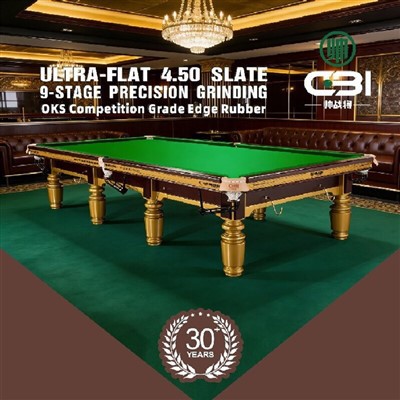
When customizing billiard tables that meet competition standards, billiard table manufacturers must strictly control five core links: design specifications, material selection, production processes, quality inspection, and personalized customization. The specific process and technical key points are as follows:
1. Design specifications: Strictly follow international and domestic standards
Dimensional accuracy
Snooker table: Inner edge dimensions 3569mm×1778mm (±13mm), diagonal approximately 3.99 meters, pocket width 85mm (corner pocket) and 100mm (waist pocket), height 850mm±26mm.
Chinese eight-ball billiard table: Inner edge dimensions 2540mm×1270mm (±5-9mm), the shortest distance between the inner edge of the pocket opening corner pocket is 10.5cm±1mm, the width of the waist pocket is 12cm, and the height is 800-850mm.
American nine-ball billiard table: Inner edge dimensions 2840mm×1420mm, pocket opening suitable for 56mm diameter billiards, height uniformly 850mm±50mm.
Manufacturers need to select the corresponding standards based on the type of competition (such as international events or domestic leagues) to ensure that the dimensional error is within the allowable range.
Structural stability
The frame is made of thickened steel or hardwood (such as bluestone, oak) to ensure that the flatness error of the countertop is ≤0.5mm and prevent deformation.
The edge of the cue (table edge) is made of high-elasticity rubber, and its rebound coefficient complies with international standards (for example, the rebound height of the cue edge in snooker needs to reach two-thirds of the ball's height).
2. Material selection: High-end materials ensure performance
Countertop
Stone slabs: Imported bluestone slabs or domestic first-class stone slabs are selected, with a thickness of ≥45mm. They are precisely ground to ensure flatness.
The table wool: Made of pure wool and smooth wool table wool (such as the Libaiwen brand), it is highly wear-resistant, with consistent smooth wool direction, reducing ball movement deviation.
Accessories
The ball bag: It features a hard molded thickened leather opening that seamlessly connects with the panel to prevent the ball from spitting out.
Cue sticks: Customization service is provided. They are made of North American maple or carbon fiber. The weight and balance point can be adjusted according to the player's requirements.
Billiards: It meets international competition standards (such as a snooker ball with a diameter of 52.5mm and an American ball with a diameter of 56mm), and is made of phenolic resin or ceramic.
3. Production process: A combination of intelligence and refinement
Frame assembly
Use CNC machine tools to cut steel or wood to ensure the precise dimensions of each component.
High-strength bolts or mortise and tenon structures are used at the connection points of the frame to enhance stability.
Countertop installation
The stone slabs are laid in layers, with shock-absorbing materials (such as rubber pads) filled in the middle to reduce the impact of vibration on hitting the ball.
The tensioning of the table fabric is carried out with special tools to ensure uniform tension on the fabric surface and no wrinkles.
Bag opening debugging
Use laser calibration equipment to adjust the Angle and width of the bag opening to ensure compliance with standards (for example, the slope of the snooker bag opening should be such that the ball enters the bag at an Angle of 30°-45°).
4. Quality Inspection: Multi-link control
Flatness inspection
Use a laser level to inspect the tabletop, with an error of no more than 0.3mm.
Conduct a simulated hitting test to observe whether the ball path moves in a straight line without any deviation.
Elasticity test
Rebound height detection at the edge of the vault: The ball drops freely from a height of 30cm, and the rebound height must reach 20cm (snooker standard).
Bag opening ball grip force test: Ensure that the ball does not pop out after entering the bag at a reasonable Angle.
Durability test
Simulate long-term usage scenarios, hit the ball continuously for more than 1,000 times, and check the wear of the table fabric and the deformation of the frame.
5. Personalized customization: Meeting special needs
Brand and Logo
Customers can request that logos, event names, etc. be printed on the tabletop, pockets or pockets using laser engraving or silk-screen printing technology.
Function expansion
Integrated with an intelligent scoring system, LED lighting or audio equipment, it is suitable for high-end events or commercial venues.
Spatial adaptation
Adjust the outer edge size of the billiard table according to the size of the venue (for example, reduce it to 2.6 meters ×1.4 meters for the household model), while maintaining the standard inner edge.