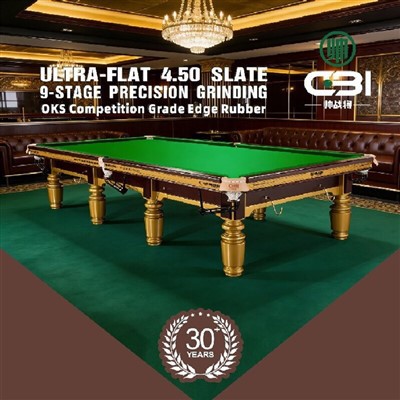
To ensure the best hitting experience, the adjustment of the billiard table needs to focus on the following aspects:
1. Installation environment inspection
The ground requirements: The billiard table should be placed on a flat, hard and unobstructed ground to ensure its stability and service life.
Space requirements: Ensure there is sufficient space around the billiard table so that players can move and swing freely. The standard dimensions of a Chinese pool table are 285cm in length, 155cm in width and 85cm in height. It is recommended that the length and width of the room be at least 5.8 meters by 4.5 meters and the height be at least 2.7 meters. At the same time, the distance between the billiard table and the wall should be at least 1.5 meters, from low furniture at least 0.7 meters, and from tall furniture at least 1.2 meters.
2. Level adjustment
Use a level to check the four corners and the center position of the billiard table to ensure that the table surface is completely level.
If you find that the table surface is uneven, you can adjust it to be level by adjusting the regulating feet at the bottom of the billiard table. After the adjustment is completed, use the level again to confirm.
3. Stability check
Gently push one corner of the billiard table to feel its stability and load-bearing capacity.
If you find that the billiard table is shaking or unstable, you can further check whether its installation parts are tight or adjust the regulating feet to enhance stability.
4. Adjustment of the billiard pocket
Check the installation of each billiard pocket to ensure that the pocket opening is vertically aligned with the table surface.
If you find that the bag opening is tilted or misaligned, you can adjust the Angle of the bag opening to make it perpendicular to the countertop.
At the same time, check whether the rubber ring inside the bag opening is intact to ensure that the billiard ball can fall smoothly into the bag.
5. Countertop adjustment
Check the flatness and smoothness of the countertop to ensure there are no unevenness or scratches.
If any problems are found with the countertop, professional repair agents can be used for restoration.
At the same time, check whether the color of the countertop is uniform to ensure the comfort of the visual effect.
6. Flexible debugging
The elasticity of a billiard table is crucial for the progress of the game.
During the installation or commissioning process, it is necessary to ensure that the elastic material of the billiard table is properly adjusted to make the billiard balls bounce consistently at all positions.
7. Cleaning and maintenance
Regularly clean the surface of the billiard table and the pockets to prevent the accumulation of dust and dirt.
Use a soft cloth or vacuum cleaner to gently wipe the desktop to ensure it is clean and tidy.
Avoid touching the billiard table with sharp objects or chemical cleaners to prevent damage to its surface.
8. Actual usage test
After the debugging is completed, conduct several actual batting tests.
Feel the elasticity and rebound effect of the billiard table, as well as the trajectory of the billiard ball after impact.
If it is found that the billiard ball bounces unstably after being hit or there are other abnormal conditions, the installation and debugging of the billiard table can be further inspected and corresponding adjustments can be made.
In conclusion, by carefully inspecting and adjusting all the parameters and components of the billiard table, it can be ensured that the table has good stability and accuracy during use, providing players with a high-quality billiard experience. At the same time, regular cleaning and maintenance are also key to maintaining the performance and service life of the billiard table.