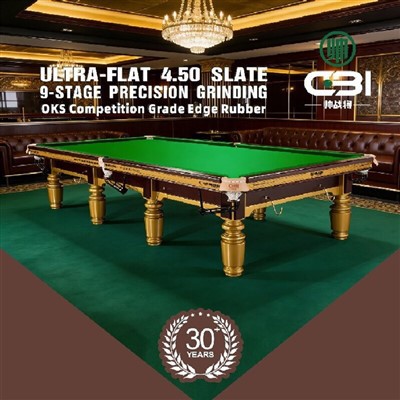
The key points of quality control in the production of billiard tables mainly include the following aspects
1. Raw material quality control
High-quality wood: The tabletop and legs of a billiard table are usually made of wood, so it is necessary to choose high-quality wood that is hard in texture, high in density and resistant to corrosion, such as maple and oak. The wood needs to be strictly screened to ensure it is free of cracks, decay, insect damage and other problems.
Environmentally friendly coatings: During the surface treatment process of billiard tables, coatings need to be sprayed. To ensure the environmental friendliness and safety of the product, environmentally friendly coatings that are non-toxic, odorless, and harmless to both the human body and the environment should be selected.
Metal accessories: For the metal accessories of the billiard table, such as table leg connectors and screws, it is necessary to choose materials that are strong, durable and not prone to rust to ensure the stability and durability of the billiard table.
2. Quality control in the production process
Wood processing: Wood needs to be precisely cut according to the designed dimensions and shapes to ensure the dimensional accuracy and shape consistency of each component. During the cutting process, it is necessary to pay attention to protecting the texture and color of the wood and avoid damage.
Surface treatment: The wood is subjected to processes such as sanding and painting to make its surface smooth and flat with uniform color. During the grinding process, attention should be paid to the force and uniformity to avoid overgrinding or undergrinding. When spraying paint, it is necessary to control the amount and uniformity of the coating to ensure that the coating thickness is moderate, free of bubbles, peeling and other problems.
Assembly process: Assemble the desktop, table legs, ball bags and other components in accordance with the design requirements. During the assembly process, attention should be paid to the fit accuracy and firmness of each component to ensure that the billiard table is stable as a whole and free from shaking after assembly. At the same time, assembly should be carried out in accordance with the prescribed steps and sequence to avoid omissions or incorrect installation.
3. Finished product quality inspection
Levelness inspection: Use a level to inspect each corner of the billiard table to ensure they are on the same horizontal plane. If any unevenness is found at a certain corner, it needs to be adjusted in time to ensure that the entire billiard table is in a level position.
Stability test: Gently shake each part of the billiard table to observe if there is any loosening or shaking. If unstable components are found, they need to be adjusted or replaced in a timely manner.
Elastic adjustment: The elasticity of a billiard table is crucial for the smooth progress of the game. Therefore, during the quality inspection stage of the finished product, it is necessary to adjust the elastic material of the billiard table to ensure that the bouncing effect of the billiard balls is consistent at all positions.
Flatness inspection: Place a ruler on the billiard table and observe whether the gap between the ruler and the surface of the billiard table is uniform. If any unevenness is found, adjustments should be made promptly to ensure the flatness of the entire billiard table.
4. Other quality control measures
Regular training and assessment: Regularly conduct skills training and assessment for production workers to enhance their operational skills and quality awareness. Meanwhile, an incentive mechanism should be established to encourage workers to actively participate in quality control activities.
Establish a quality management system: Establish a complete quality management system, including setting quality objectives, formulating quality standards, compiling quality plans, and implementing quality assurance measures, etc. Through systematic management, ensure that quality control during the production process of billiard tables is effectively implemented.
After-sales service and feedback: Provide high-quality after-sales service, promptly collect customers' feedback, and rectify and improve existing problems. At the same time, establish customer files, conduct regular follow-ups and satisfaction surveys with customers to understand their needs and expectations, and provide a basis for the continuous improvement of product quality.
To sum up, the key points of quality control in the production of billiard tables involve multiple aspects such as the quality control of raw materials, the quality control during the production process, the quality inspection of finished products, and other quality control measures. The implementation of these measures helps ensure the quality stability and reliability of billiard tables and enhance the market competitiveness of the products.