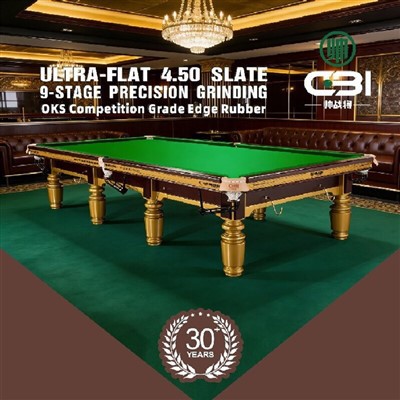
When choosing home and commercial snooker tables, the five core differences are usage strength, space adaptation, material durability, functional design, and budget allocation, which directly determine the product's applicability.
1. Usage intensity: High-frequency hitting vs. daily entertainment
Commercial use: It must withstand continuous impact for an average of 8 to 12 hours per day (such as in clubs and sports venues). The frame must be made of thickened solid wood or heavy steel frame (such as table leg diameter ≥10cm). The table fabric must have wear resistance of more than 50,000 times (such as Libaiwen 68577), and the rubber edges must pass extreme temperature tests (-20℃ to 50℃) to ensure no deformation during long-term use.
For household use: Use it for 2-3 hours a day. The frame should be stable, but pay attention to the roundness of the corners (to prevent family members from bumping into it). For the countertop, you can choose a domestic model with the same fleece weight (40% lower in price). Regular ironing and maintenance are sufficient.
2. Space Adaptation: Site efficiency vs. Home Layout
Commercial use: The space of the venue must be strictly calculated (formula: table length +1.5 meters is the short side space, table width +1.8 meters is the long side space). For example, a 9-foot table requires at least 50 square meters, and areas for storing golf clubs and for spectators to watch the game must be reserved.
Home use: You can flexibly choose the 6-foot folding model (the volume is halved after storage), which is suitable for balconies or studies. If there is sufficient space, the 8-foot standard model can be chosen, but it is necessary to ensure that the short side leaves a passage of more than 1.2 meters.
3. Material durability: Anti-wear vs. cost performance
Countertop stone slabs
Commercial use: Only natural bluestone slabs with a thickness of ≥30mm (high density and anti-deformation) must be used, and the joint gap should be no more than 0.05mm.
For household use: 25mm thick bluestone slabs or composite slabs can be selected, but it is necessary to check whether the joint gap is ≤0.1mm.
Rubber edge and steel warehouse
Commercial use: 12mm type I spring steel silo (rebound Angle error ≤1°) is adopted, and the rubber edge needs to pass a 5-year aging test.
For household use: You can choose an 8mm steel warehouse or a high-quality wooden warehouse. The elasticity of the glue edge should be moderate to avoid low-priced composite glue edges (which are prone to cracking).
4. Functional Design: Efficiency First vs. Experience Optimization
Commercial use: Emphasis is placed on table turnover rate and maintenance convenience, such as lockable ball boxes (to prevent ball loss), automatic ball collectors, and detachable floor MATS (for easy cleaning).
Household use: Focus on storage and noise reduction, such as drawers under the table, side cabinets (for storing ball rods), and thickened shock-absorbing pads (to reduce noise).
5. Budget Allocation: Long-term Costs vs. Initial Investment
Commercial use: The cost of a single unit is usually 2 to 3 times that of a household model (for example, the price of the Xingpai XW101-12S is about 80,000 yuan), but the long-term usage cost of more than 5 years needs to be considered (including the replacement of the frame and the maintenance of the rubber edges).
Household use: The budget is concentrated on the initial investment (for example, a mid-to-high-end model can be purchased with 30,000 to 50,000 yuan), and the maintenance cost is low (the table cloth needs to be replaced every 3 to 5 years, and the rubber edge needs to be replaced every 5 to 8 years).
Summary: Commercial tables are "wear-resistant tools" and need to withstand high-frequency wear and tear in accordance with professional standards. Household tables are "experiential furniture" and need to balance functionality and cost-effectiveness within a limited space. Only by matching the core parameters according to the usage scenarios can the embarrassment of "commercial tables being left idle at home" or "household tables being scrapped in the club after half a year" be avoided.